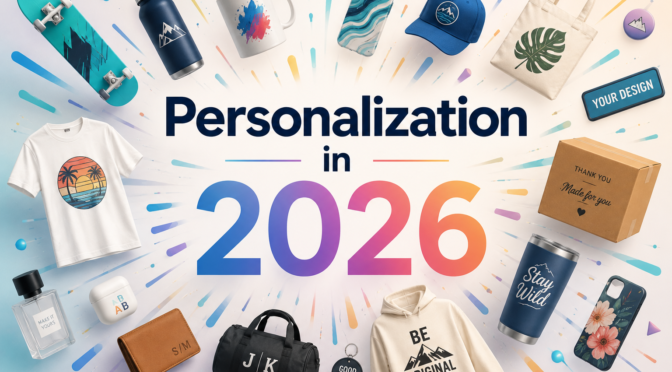
As we pass the halfway point of 2026, one thing has become abundantly clear: personalization isn’t slowing down. If anything, it’s becoming one of the strongest competitive advantages an ecommerce business can have.
A few years ago, offering customized products helped brands stand out from the competition. Today, customers increasingly expect shopping experiences built around their preferences, interests, and identities. Generic products and one-size-fits-all experiences simply don’t generate the same excitement they once did.
What’s especially interesting is that despite the rapid rise of artificial intelligence, consumers still want to be part of the creative process, especially when the content is personal photos from our phones, or branding, there’s really no AI replacement for that.
The Shift From Recommendations to Participation
AI has transformed ecommerce. Personalized product recommendations, dynamic content, and tailored marketing messages are now commonplace.
But those innovations represent only one side of personalization.
The other side is participation.
Whether it’s adding a name to a product, uploading artwork, selecting colors, choosing finishes, or building an item from scratch, customers increasingly expect the ability to influence the products they purchase.
Customization transforms a transaction into an experience.
Instead of simply buying a product, customers become co-creators.
Many users leverage AI by generating graphics to use, but whether it’s graphics or photos, images or a personal message in text, users want the ability to make products uniquely theirs more and more, and our tools provide that.
Why Personalized Products Continue to Thrive
Several factors continue to drive the growth of product personalization in 2026 as they always have:
Emotional Connection
Personalized products often carry greater meaning. They commemorate milestones, celebrate relationships, showcase identity, and reflect personal taste. That emotional investment creates stronger connections between customers and brands.
Higher Perceived Value
When shoppers help create a product specifically for themselves, price often becomes less of a deciding factor. The item is no longer interchangeable with dozens of competing products. This is especially true with gift giving.
Increased Engagement
Interactive design experiences encourage visitors to spend more time exploring. Live previews, configurators, and customization tools invite experimentation and discovery.
Differentiation in Crowded Markets
As online marketplaces become increasingly saturated, businesses need more than competitive pricing to stand out. Offering personalized products creates a value proposition that competitors cannot easily replicate.
Even Amazon and Etsy Are Investing in Personalization
Perhaps the clearest indication of where the market is headed is this: even the world’s largest ecommerce marketplaces have embraced personalization.
Amazon has expanded its Amazon Custom program, allowing sellers to offer personalized products with text, images, logos, and configurable options directly through its marketplace. Etsy continues to enhance its personalization capabilities, making it easier for sellers to collect custom details from buyers and offer made-to-order products at scale.
The message is clear.
Personalization is no longer a niche strategy reserved for a handful of innovative brands. It has become a mainstream expectation.
However, marketplace personalization tools are designed to accommodate millions of sellers through standardized workflows. For many businesses, those capabilities provide a useful starting point, but they can be limiting when brands want to deliver a truly immersive customization experience.
Advanced product configuration, real-time visual previews, sophisticated business rules, complex pricing logic, multi-step workflows, seamless ecommerce integrations, and complete control over the customer journey often require a purpose-built solution.
That’s where specialized personalization platforms continue to make a difference.
At MyStyle, we’ve always believed that personalization should be more than a text field attached to a product listing. Customers should be able to visualize their creations, explore possibilities, and purchase with confidence, knowing exactly what they’re going to receive. The product isn’t dry and generic anymore, so why would the experience be?
The experience itself matters.
The Businesses Winning in 2026
The brands thriving this year aren’t necessarily the ones with the largest advertising budgets.
They’re the ones creating memorable experiences.
They’re empowering customers to participate.
They’re recognizing that personalization isn’t simply a marketing tactic—it’s a product strategy.
From promotional products and apparel to gifts, home décor, sporting goods, industrial products, and specialty retail, businesses across industries are discovering that giving customers creative control leads to stronger engagement, increased loyalty, and higher conversion potential.
Technology Has Finally Caught Up
For years, many businesses viewed customization as complicated, expensive, or technically overwhelming.
That barrier is disappearing.
Modern personalization platforms like MyStyle provide live previews, flexible workflows, ecommerce integrations, scalable infrastructure, print production tools, and production-ready outputs that make selling customized products more accessible than ever before.
Businesses no longer have to choose between operational efficiency and customer creativity. They can have both.
Looking Ahead
If the first half of 2026 has taught us anything, it’s that personalization isn’t a passing trend.
Consumers continue to seek products that reflect who they are. They want experiences that feel relevant, authentic, and interactive. They want to participate in the products they buy, not simply choose from a list of predefined options. And, they want to make something special for their special someone. All of this comes with a justified higher price point, and consumers expect that and are ok with that because they see more value there.
The brands that embrace this shift won’t just keep pace with changing expectations. They’ll help define what the future of ecommerce looks like and continue to stay competitive.
At MyStyle, we’ve always believed that customers want more than products—they want ownership of the experience. Looking at trends in 2026, that belief has never been stronger.
The question is no longer whether personalization matters. The question is how your business can use it to create something unforgettable.
Whether you have an existing MyStyle solution or are looking to get one going, chat with us and let’s explore how to make the most of personalization for your products.
